

Price elasticity
Price elasticity is a measure of the relationship between quantity demanded and price. It shows how responsive (elastic) the quantity demanded of a product or service is for a given change in price, with all other things remaining the same.
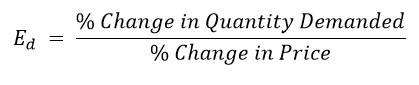
Below is the formula for Elasticity of Demand:
Elastic Products
When elasticity is greater than 1 in absolute terms, we say that the product is elastic.
If there is a small % change in price and proportionately a much larger % change in quantity, we say that the product is elastic, or sensitive to a change in price. Example, a products price increases by 10% and the quantity demanded decreases by 20%, the elasticity will be -2. We can say that for a 1% increase in price, quantity demanded will decrease by 2% and that the product is elastic.
Elastic products tend to be your lower priced ranged products, or mainstream market goods, most likely with many competitors or substitutes available.
Inelastic Products
When elasticity is smaller than 1 in absolute terms, we say that the product is inelastic.
If there is a small % change in price and a proportionately small % change in quantity, we say that the product is inelastic, or not sensitive to a change in price. Example, a products price increases by 10% and the quantity demanded decreases by 4%, the elasticity will be -0.4. We can say that for a 1% increase in price, quantity demanded will decrease by 0.4% and that the product is inelastic.
Inelastic products tend to be your more premium products offering a unique value proposition and perhaps with few competitors or substitutes available.
Graphical representation of product elasticities:
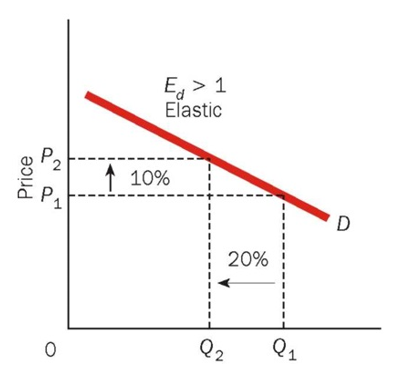
Fig 1. Elastic Demand: for a 10% change in price we have a 20 % decrease in quantity demanded.
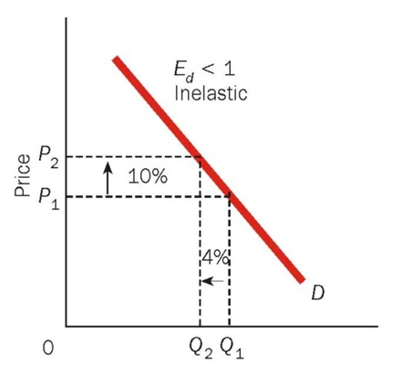
Fig 2. Inelastic Demand: for a 10% increase in price we have a 4% decrease in quantity demanded.
Positive Price Elasticity
We have only spoken about negative price elasticity. The reason for this is because most products have a negative relationship between quantity demanded and price. But there are certain circumstances where a positive price elasticity may exist, however this is extremely rare. An example is of a limited edition luxury car, where the car is very exclusive and as price increases, so does the perception of its value and hence demand.
What does it mean for your business?
When considering a price change for your product or service, it’s important to understand the elasticity of your product. It’s not a good idea to drop your price if you have an inelastic product. You don’t want to decrease price and not have the expected increase in your sales. So make sure you understand the possible consequences before changing the price, so as “not to leave money on the table”.
We hope you have found this article useful and you now have a better understanding of price elasticity. Please get in touch if you would like to learn more about how we can assist you with your business reporting requirements.